


Reporting for RIAs and family offices
One book of record. Read-only. No advice.
You get a single consolidated book from Schwab, Fidelity, Pershing, and the private marks your firm enters. Command Stone measures and reports. It does not rate, score, or recommend.
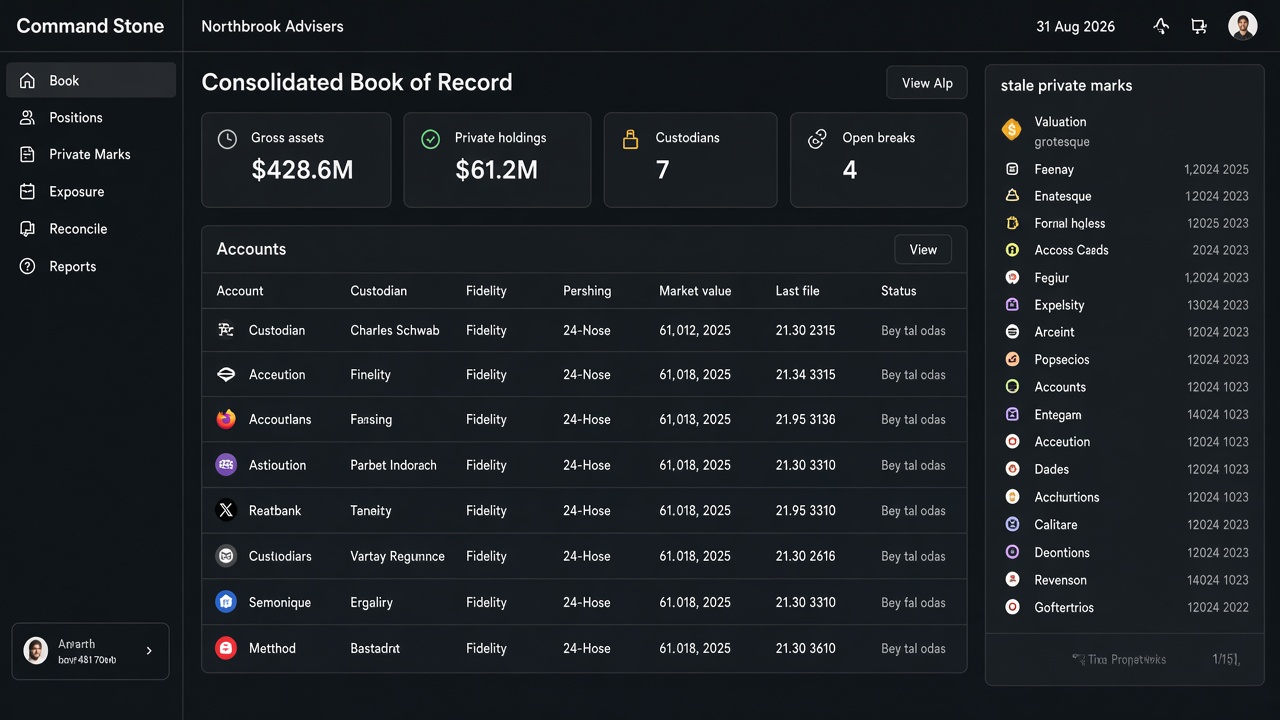
 Stonebook · Northbrook Advisers
2-12
Custodians in one book
$75M-$2B
Typical firm AUM range
EOD
Marks, never live quotes
2-12
Custodians in one book
2-12
Custodians in one book
$75M-$2B
Typical firm AUM range
EOD
Marks, never live quotes
2-12
Custodians in one book

0
trades placed. Custody stays with your custodian.
Read-only connections only
What we report
Four surfaces. One book of record.
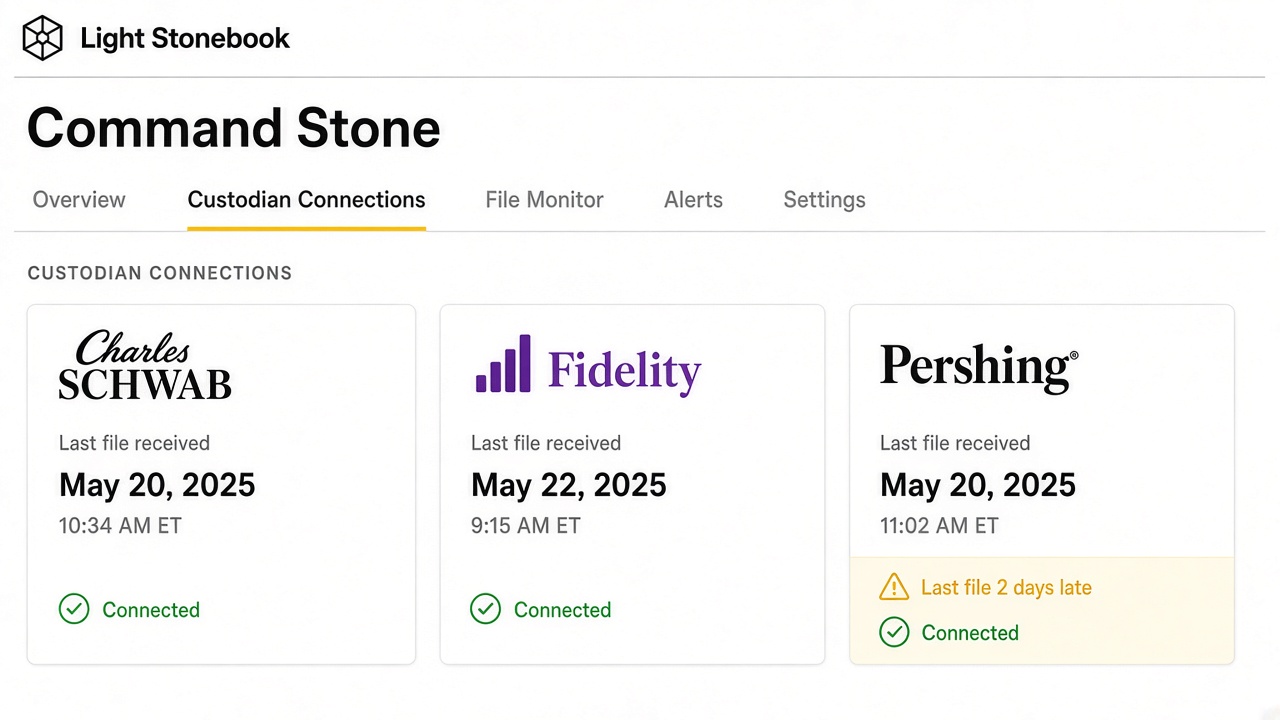
 Custodian files
Custodian Consolidation
Read-only feeds from Schwab, Fidelity, Pershing, and the rest of your roster, mapped into one position and transaction book.
Includes:
Read-only custodian feeds
Position and lot mapping
Automated recon flags
End-of-day security marks
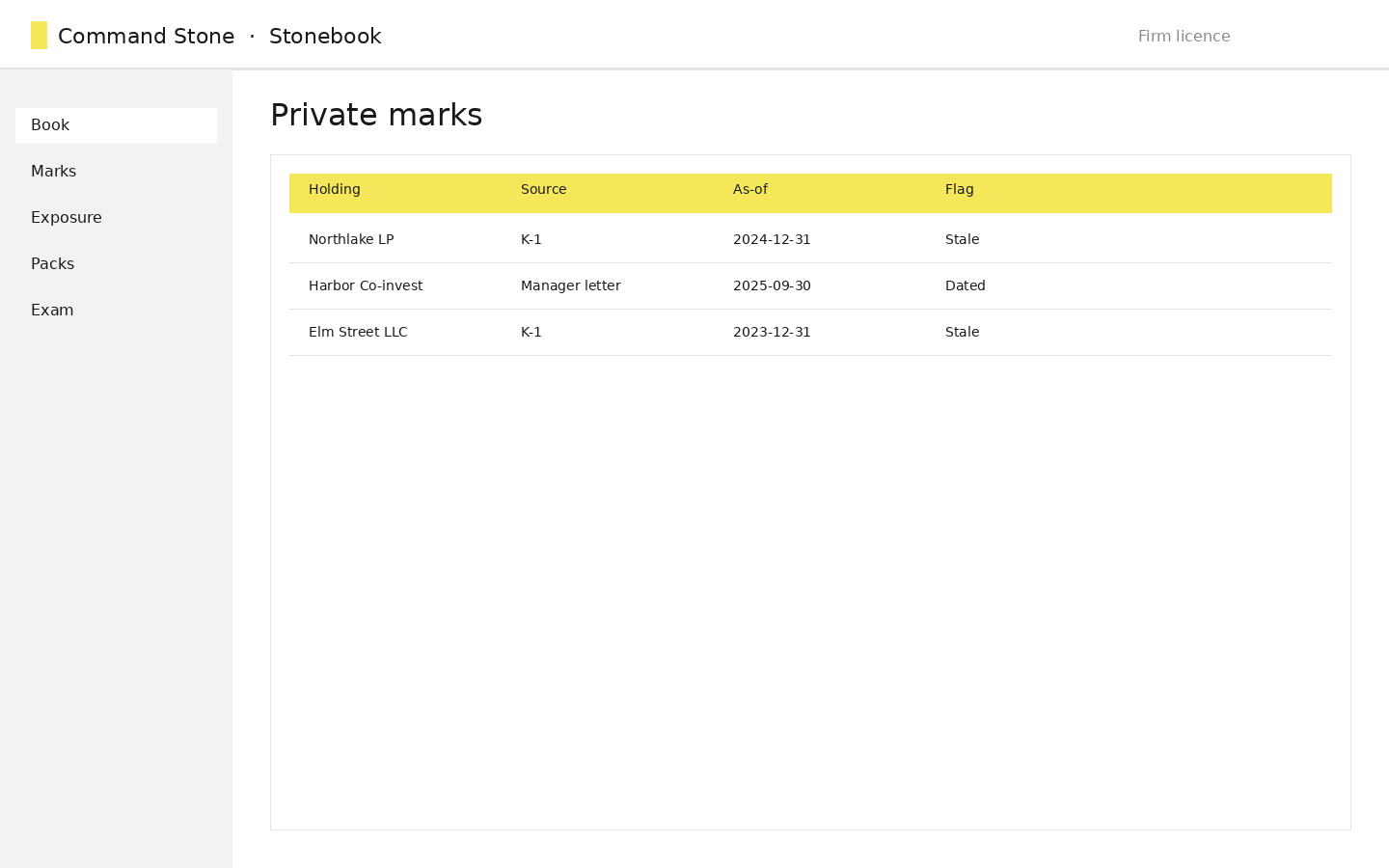
Private Holdings Ledger
You enter the valuation. We print it with the date. A stale mark is flagged on the report. It is never interpolated.
Includes:
Client-supplied marks
Valuation date on every line
Stale-mark flags
Entity and ownership tags
Exposure and Concentration
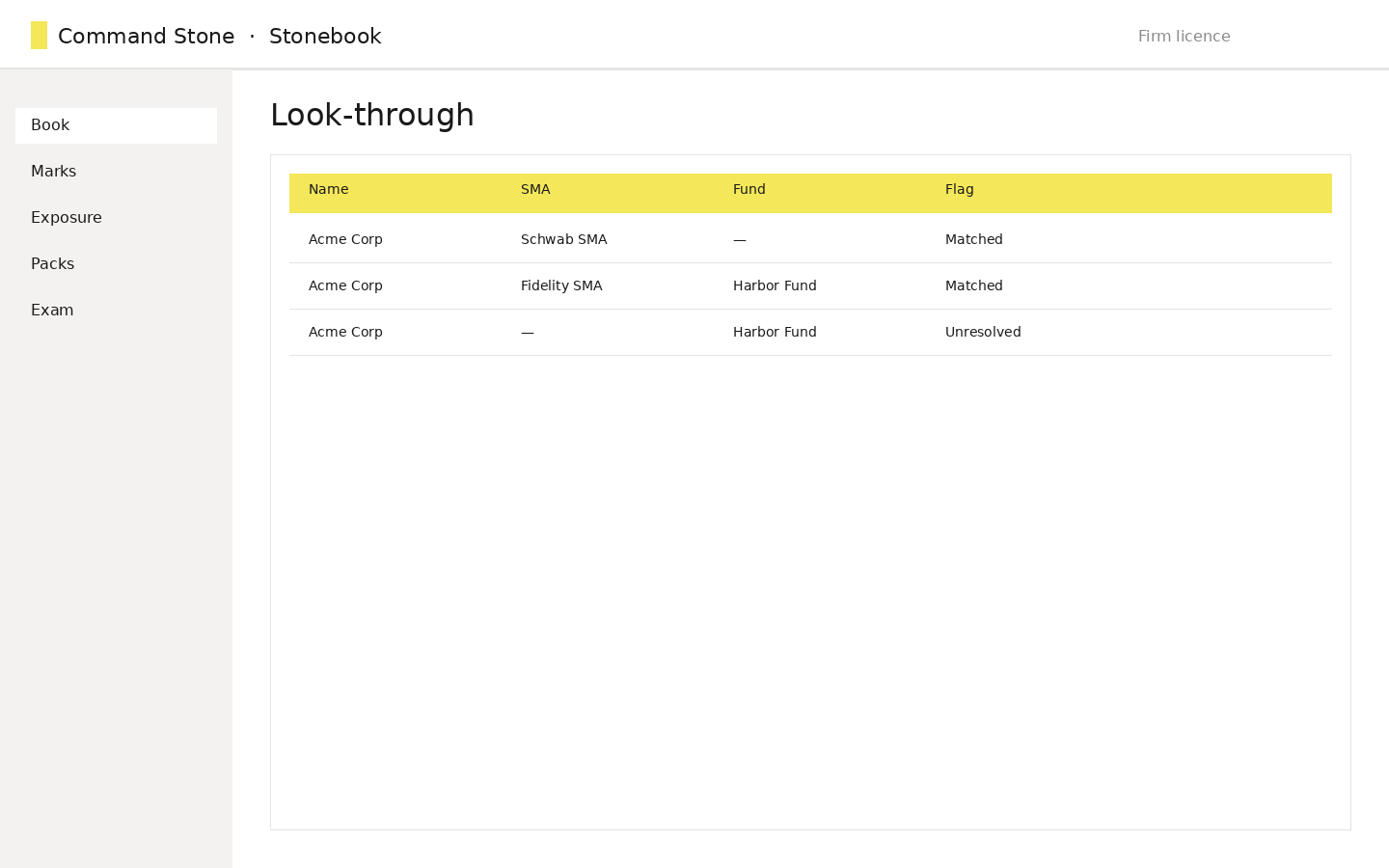
Look-through across SMAs, pooled vehicles, and the private book, using the limits your firm configured.
Includes:
Look-through exposure
Firm-set policy limits
Issuer and sector cuts
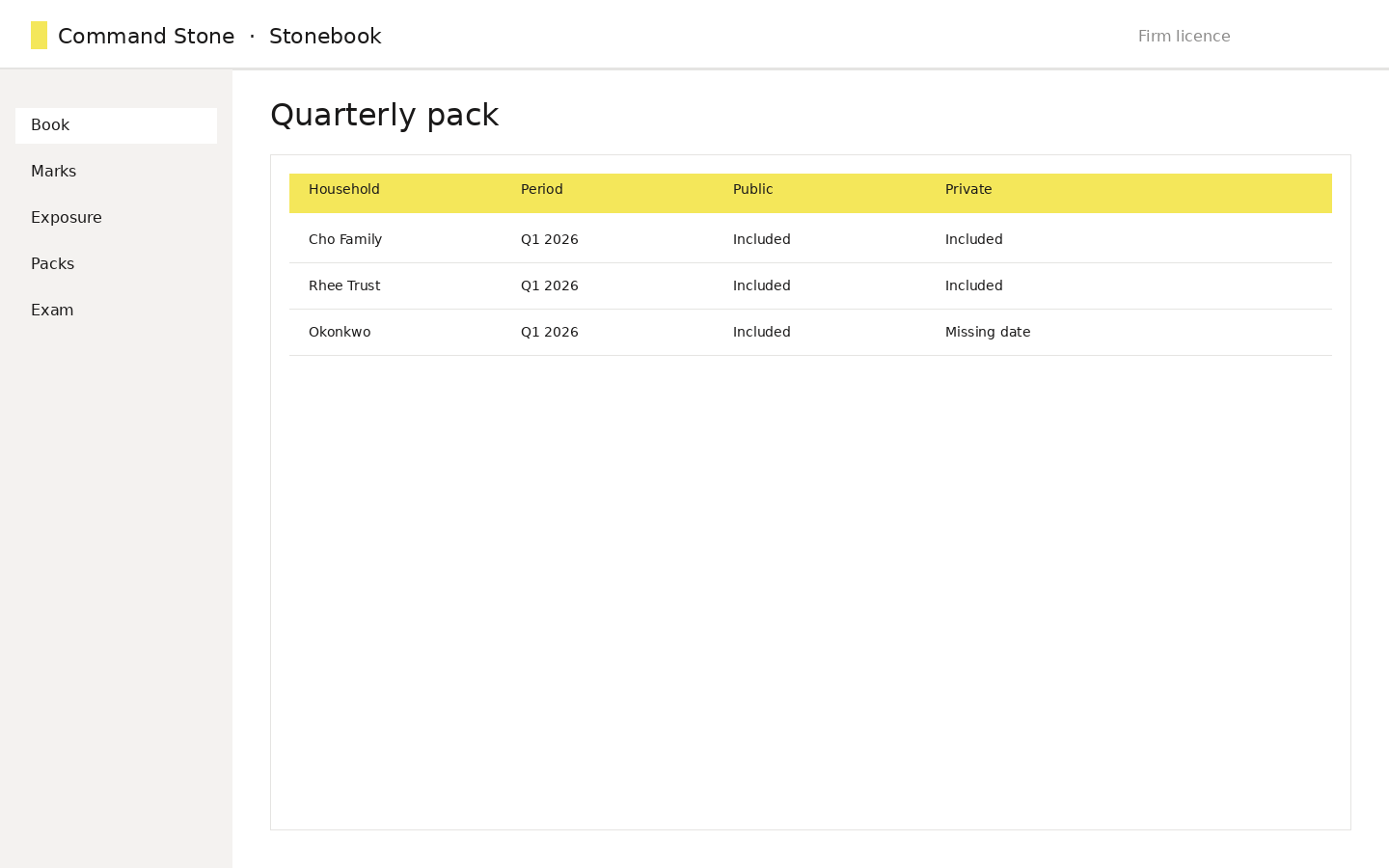
Quarterly Client Packs
Performance, exposure, and recon reports drawn from the same book, ready to produce when an examiner asks.
Includes:
Household and entity grouping
Audit-ready history
Firm-configured thresholds
How the book is built
From custodian files to a dated, reconcilable book
The platform does not invent numbers. It receives what custodians send, records what you enter for private assets, and flags the gaps.
01 — Week 1-2
Connect
You designate the custodians. We establish read-only connections. No login we hold can move cash, place a trade, or change an instruction at Schwab, Fidelity, or Pershing.
02 — Week 2-4
Map
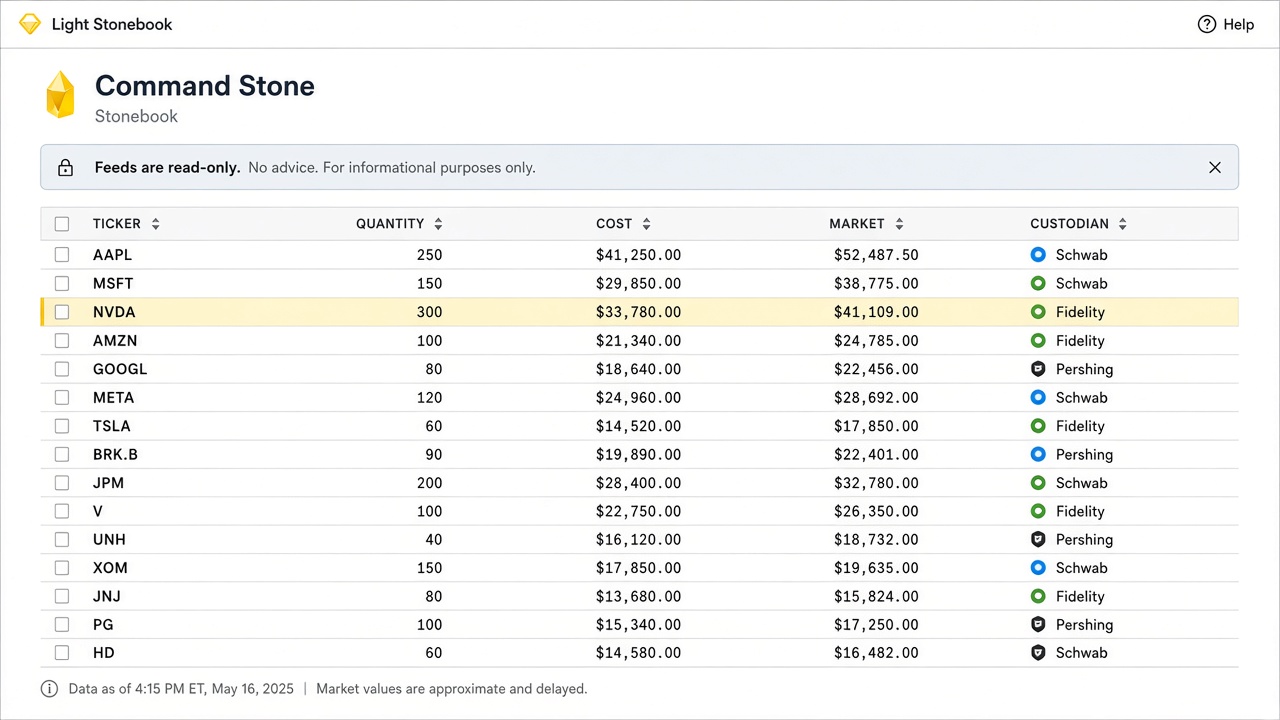
Positions, lots, and account titling land in one book. Households and entities are grouped the way your firm already reports, not the way a custodian labels a file.
03 — Week 4-10
Mark
Listed securities take the end-of-day mark. Private holdings take the value and date you supply. If that date is old, the report says so.
04 — Week 10-12
Reconcile
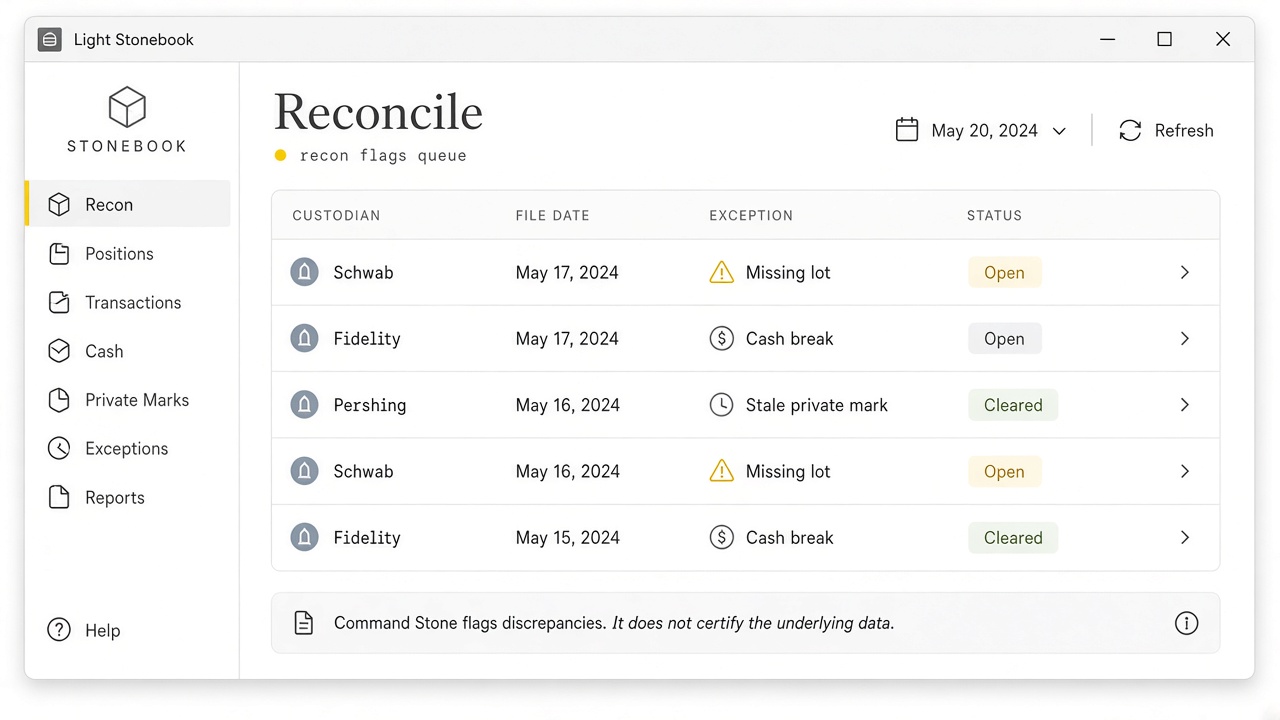
The platform flags apparent discrepancies across custodians and against the private ledger. It does not audit or certify the underlying data.
05 — Ongoing
Report
Quarterly packs, exposure views, and historical records come from the same book. Your firm stays responsible for advice, supervision, and what you tell clients.

Chief operating officer
Registered investment adviser
We were reconciling seven custodians in spreadsheets every month. The book now lands in one place, and the flags tell us where a file failed before a client ever sees it.

Chief compliance officer
Family office
Private marks used to get quietly rolled forward. Command Stone prints the date we entered. If it is old, the report says it is old. That is the record I want in an exam.

Operations lead
Multi-custodian RIA
Per-household pricing was going to cost more than the reporting itself. A firm licence with unlimited seats meant the whole ops team could log in without a seat argument.

Operations director
Advisory firm
The last exam asked for two years of household packs with the private book included. We pulled them from Stonebook in an afternoon instead of rebuilding the files by hand.

Marisa Veld
COO, Oakline Partners
Look-through across three SMAs showed the same issuer stacked past the household limit we wrote. The book put that number on one line. We stopped adding it up by hand.

Tomas Nguyen
CCO, Brightwater RIA
The custodian file was posted that morning. The private mark was still last year's. Stonebook showed posted next to stale on the same household. That is the split I need before a committee.

Aisha Rahman
Ops Director, Linden Street Advisors
A cash break sat between Schwab and the household for two days. The flag stayed on the book until ops closed it. Nobody had to hunt the line in a spreadsheet.

Principal
Family office
Quarterly packs used to be a second set of files. Now the pack prints from the same book we reconcile. The household sees the as-of we actually posted.

Elena Vasquez
COO, Harborfield Wealth
Fidelity posted three hours late. The book kept the prior as-of instead of filling the gap. We sent the household what was posted, not what someone guessed.

Kwame Boateng
CCO, Sable Ridge Advisers
The examiner asked for two years of recon flags with the private book attached. We exported the file from Stonebook. We did not rebuild a binder the week before.

Principal
Multi-family office
Ops, the CCO, and the intern all logged in the first morning. Firm licence, unlimited seats. We did not spend a week arguing who gets a login.

Rajiv Mehta
Ops Director, Pellam & Co.
The GP sent a new mark dated last Tuesday. The old one stayed on the pack with the date we entered it. We posted the new mark. We did not overwrite the stale one.

Claire Brennan
COO, Glenmere Family Office
A directed brokerage account finally sat next to the SMA in one household. The book mapped both files. We stopped keeping a side list for the directed sleeve.

Samir Patel
CCO, Redcedar Advisers
We close the book on our fiscal year, not the calendar. Stonebook kept the FYE stamp on every pack. The examiner asked for that year. It was already the as-of we use.

Reconciliation lead
Multi-custodian RIA
Committee packets had three as-of dates on the cover. Now one stamp. It is the date the last custodian file posted, not the date someone printed the PDF.

Jordan Ellis
Ops Director, Fairfax Street Partners
The Pershing file failed at 2am. The flag was on the book before the morning huddle. A client never saw a household with a missing sleeve.

Why stale private marks should stay stale
Why Command Stone prints the date on a private mark and never rolls a stale valuation forward.
Category
March 14, 2022
Read More


Look-through exposure across SMAs and funds
How look-through exposure across SMAs and pooled vehicles should be reported without turning into advice.
Category
November 3, 2024
Read More

What an examiner asks to see in the book
What examiners ask to see in the book of record, and how dated private marks and recon flags belong in the file.
Category
June 19, 2020
Read More
FAQ
Questions firms ask before a licence
Direct answers to what ops leads ask before they buy Stonebook.
What does Stonebook actually do?
Stonebook is a read-only book of record. It consolidates custodian files with client-supplied, dated private marks and produces reports. Command Stone measures and reports. It does not advise, take custody, or place trades.
How is Command Stone different from a custodian portal?
A portal shows one custodian. Most firms run Schwab, Fidelity, Pershing, and more. Stonebook prints those files in one book, with the private marks and the flags for files that failed.
What size of firm do you typically work with?
Registered investment advisers and family offices that already have a multi-custodian book. Studio, Firm, and Office licences are sized by complexity, not by seat count. If you are looking for trading software, we are not the right fit.
Do you work with firms outside the US?
The company is based in Boston. We licence Stonebook to US-registered advisers and family offices. If your book is held at US custodians, you can use the product from elsewhere. We do not open a trading desk in another country.
How much does a Stonebook licence cost?
Studio is $12,000 a year. Firm is $24,000. Office is $42,000. All three are firm-level annual licences with unlimited seats. See Pricing for what each plan includes.
Is pricing per household or per firm?
Firm-level. Unlimited seats. You are not billed per household or per login. The whole ops team can log in without a seat argument.
What is included in a licence?
The book, the private ledger with dated marks, look-through where your plan includes it, and household packs. Higher plans add more custodians and longer pack history. We scope the roster before you pay.
What happens if our roster of custodians changes?
Tell us the new file name. We add it to the map. If the change needs a higher plan, we say so before any additional fee. We do not quietly expand the bill.
How do you handle client data?
You keep ownership of custodian files and private marks. We do not claim them. We do not use your book to train models or sell it. See the Privacy Policy for how we collect, use, and share information.
Will you sign an NDA before we talk?
Yes. Email support@commandstone.com and we will turn around a signed NDA. We will not ask you to send household files before that.
Who at the firm can log in?
Anyone you issue credentials to at the firm. Licences are unlimited seats so ops is not waiting on a seat. You will not share access outside your firm except as we permit in writing.
What happens after the licence term?
You can export the book you paid for. If you renew, the packs stay in place. If you do not, we retain records for a commercially reasonable period as described in the Privacy Policy, then we delete them where the law allows.
Custodian Consolidation
Read-only feeds from Schwab, Fidelity, Pershing, and the rest of your roster, mapped into one position and transaction book.